
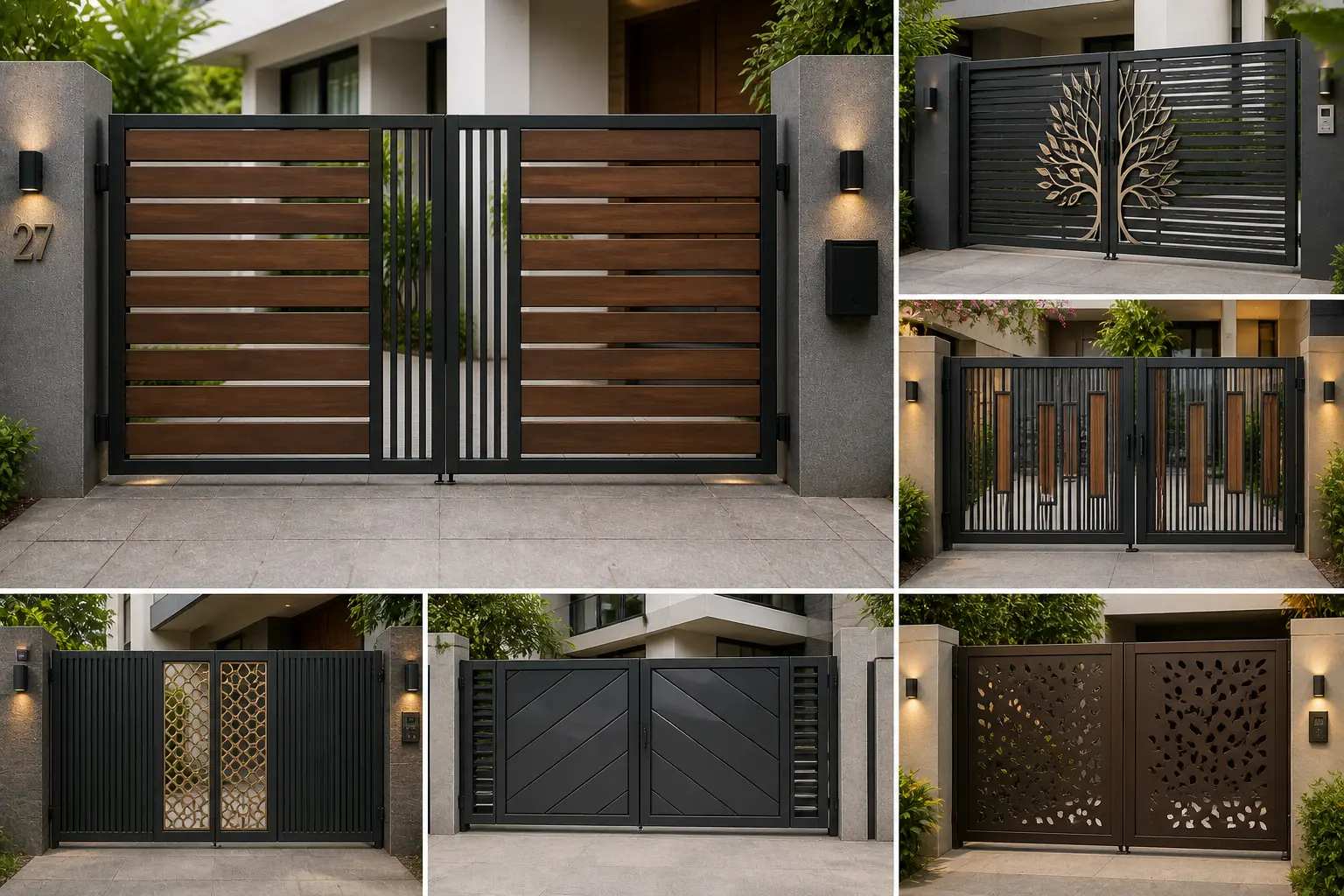
Your main gate is the first thing every visitor, neighbour and passerby notices about your home. A well-designed gate does three things simultaneously — it provides security, enhances the property's aesthetic and communicates something about the people who live there. Having fabricated gates across Mumbai, Thane, Mumbra and Kalyan for over 15 years, we know exactly what works in this city and what does not. Here is everything you need before making this decision.
Types of Main Gates — Which Suits Your Property?
Swing Gate (Single or Double Leaf)
The swing gate is the most traditional and widely installed type across Mumbai's residential plots, row houses and bungalows. The gate swings inward or outward on hinges — a single leaf for narrower openings, double leaf for standard car-entry widths.
The key requirement is clear space in front of or behind the gate for the swing arc. If your plot faces a road with enough space to reverse a car, a swing gate is almost always the most practical and cost-effective choice. It is structurally straightforward, easy to maintain and available in every material and design style.
Sliding Gate
When a swing gate is not possible — narrow lane, direct road access, or a compound with no swing clearance — a sliding gate is the right solution. The gate slides laterally on a track and requires clear wall space on one side equal to the gate's width.
We install a significant number of sliding gates in Thane and Mumbra where streets are narrow and plots open directly onto busy roads. Sliding gates can also be motorised with a remote or keypad, which is increasingly popular in gated communities and independent bungalows.
Collapsible / Accordion Gate
Where space is extremely limited and security is still required, a collapsible gate folds accordion-style into a very compact stack. It requires minimal clearance on either side. These are most commonly used for secondary entrances, parking bays, shop fronts and basement access points. They cost less than swing or sliding gates and installation is straightforward.
Laser Cut Designer Gate
For homeowners who want their gate to make a visual statement, a laser cut gate delivers results that no hand-fabricated design can match. A CNC plasma or laser cutting machine cuts precise geometric, floral or custom artwork patterns into MS or SS sheet metal. The result is a gate that functions as both a security barrier and an architectural feature.
The cost is higher than standard designs because CNC machine time and the complexity of the pattern add to fabrication cost. But the visual return — especially for a modern villa or an architect-designed home — is significant.
Material Guide — SS, MS or Wrought Iron?
Stainless Steel Main Gate is the best-performing material choice for Mumbai's climate. SS 304 handles humidity, monsoon rain and coastal air without developing rust or requiring periodic repainting. A well-fabricated SS gate installed today should still look excellent 20+ years from now. Current installed price: ₹550–₹900 per sq ft.
Mild Steel Gate with Powder Coating is the most popular choice for budget-conscious buyers and remains a solid option if maintenance is done proactively. A quality powder coat in a sheltered compound can last 8–10 years before needing attention. Outdoor-exposed gates in Mumbai's direct rain will need re-coating sooner. Installed price: ₹250–₹450 per sq ft.
Wrought Iron Gate suits traditional, heritage or colonial-style architecture. It is heavier than MS or SS and requires strong hinges and frame support. The ornate, handcrafted look is difficult to replicate in other materials. Installed price: ₹400–₹700 per sq ft.
Laser Cut MS Gate is the current market favourite for modern homes. The combination of clean CNC-cut patterns and powder coating in matte black or bronze creates a high-end look at a price accessible to most homeowners. Installed price: ₹400–₹800 per sq ft depending on design complexity.
When comparing quotes from different fabricators, always ask for the installed price including frame, hinges, lock hardware and labour. Some contractors quote only the gate leaf and add frame and hardware separately at the end. Our quotes always include everything — no surprises at installation.
Gate Size — What Are the Right Dimensions?
Getting the size right from the start is critical. A gate that is too narrow creates daily frustration; a gate that is too wide looks disproportionate and costs more than necessary.
For standard residential car entry, a clear opening of 10–12 feet is comfortable for most vehicles including SUVs. If the compound regularly receives delivery trucks or larger vehicles, plan for 14–16 feet. For bike-only or pedestrian entry through a secondary gate, 3.5–4 feet is sufficient.
Height depends on the surrounding compound wall. Gates are typically 5–6 feet for standard plots. If privacy is a concern or the surrounding wall is tall, 6–7 feet is common. Going beyond 7 feet on a residential gate tends to look institutional rather than residential.
Proportions matter more than the absolute numbers. A gate that is significantly taller than the surrounding wall looks awkward; one that is too wide for the opening looks flimsy. We always recommend on-site measurement before finalising any design.
What Gate Designs Are Most Popular in Mumbai Right Now?
Based on orders we are completing across Thane, Mumbra, Kalyan and Mumbai in 2025:
Flat panel modern gates with solid sheet infill and no ornamentation continue to dominate for high-rise compound entrances and contemporary villas. Matte black powder coat or natural SS finish — both popular.
Laser cut geometric patterns — hexagonal grids, chevron designs and custom family motifs — are the top request for independent bungalows and new residential projects.
Combination gates with a solid lower panel for privacy and vertical bars or glass inserts on the upper half are popular for properties that want visual connection to the street without fully compromising privacy.
CNC-perforated privacy screens combined with gates are a newer trend where the side compound panels also carry a matching laser cut pattern, creating a cohesive entrance design.
For any custom design, we create a detailed CAD drawing for your approval before fabrication begins. You see exactly what the finished gate will look like — proportions, pattern, handle and lock placement — before any steel is cut. Changes at the drawing stage cost nothing; changes after fabrication do.
Common Mistakes Homeowners Make When Installing a Gate
The single most expensive mistake is not measuring the opening correctly before ordering. A gate fabricated 3 inches too wide or too narrow cannot be easily adjusted — it typically means remaking it. We provide free on-site measurement as part of our process for exactly this reason.
The second most common mistake is specifying good fabrication but cheap hardware. A gate is only as reliable as its hinges and lock. Heavy gates — especially MS or wrought iron double-leaf designs — need heavy-duty industrial hinges that can support the weight over decades. Low-grade hinges sag within 1–2 years and cause the gate to bind or drag on the ground.
The third mistake is applying coating only to the visible faces of the gate while leaving weld joints, cut edges and back surfaces uncoated. Rust always starts from the points of least protection. Every joint, every cut edge and every back surface needs primer and topcoat — this is standard in our process.
Serving Mumbai, Thane, Mumbra and Kalyan
We fabricate and install main gates across the entire MMR (Mumbai Metropolitan Region). For narrow lane properties, we section-fabricate the gate so it can be brought in and assembled on-site without requiring large vehicle access. For housing society